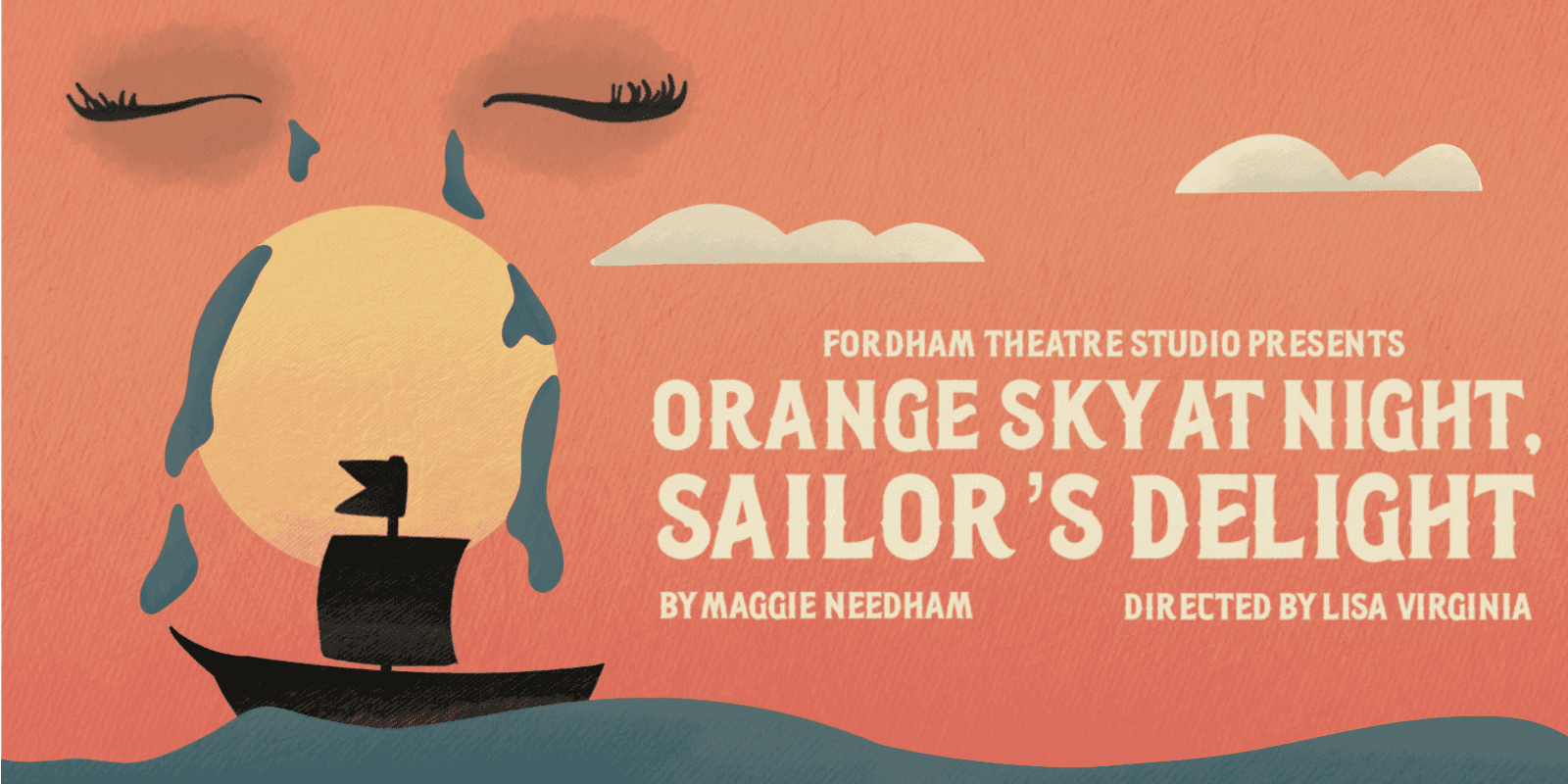
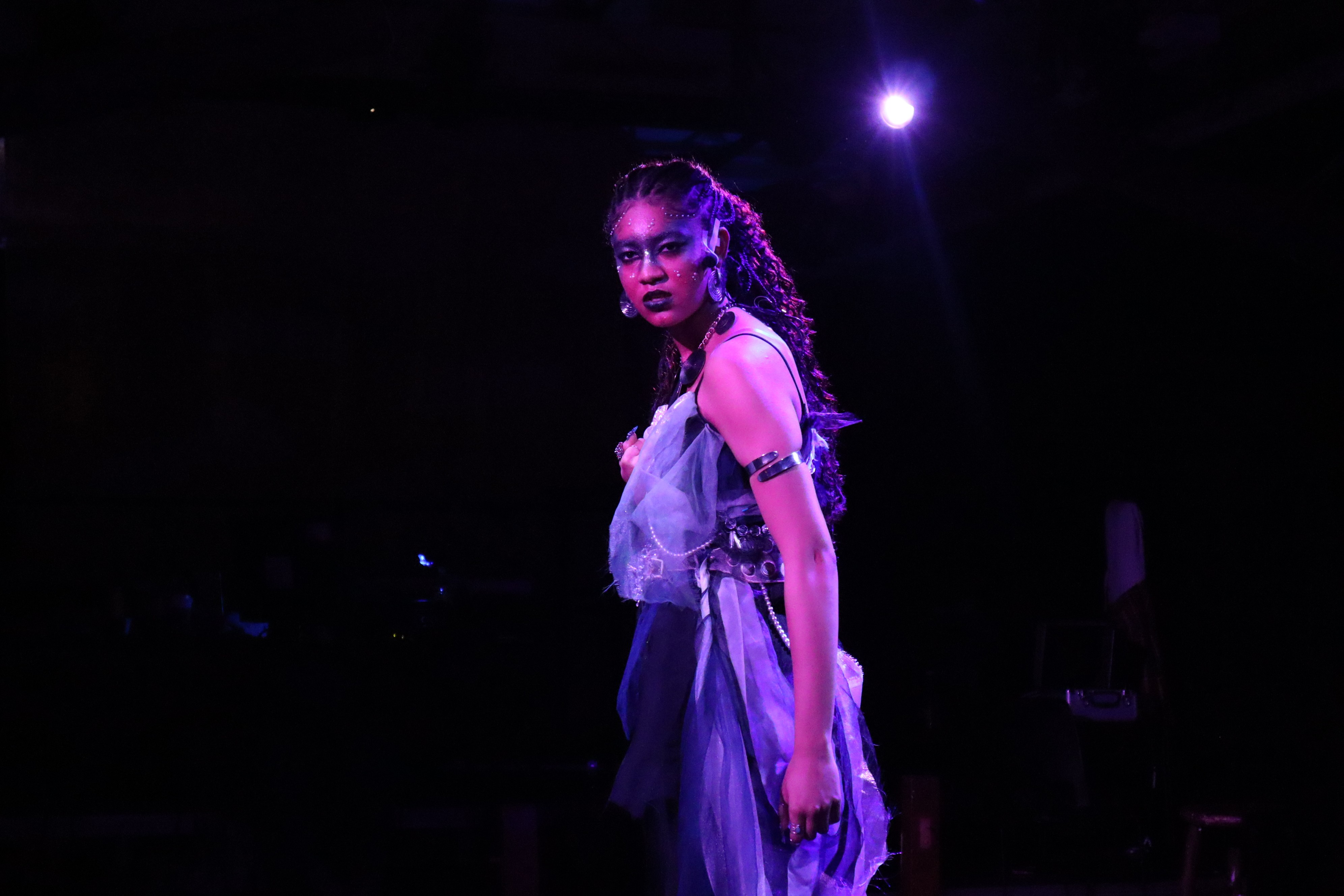
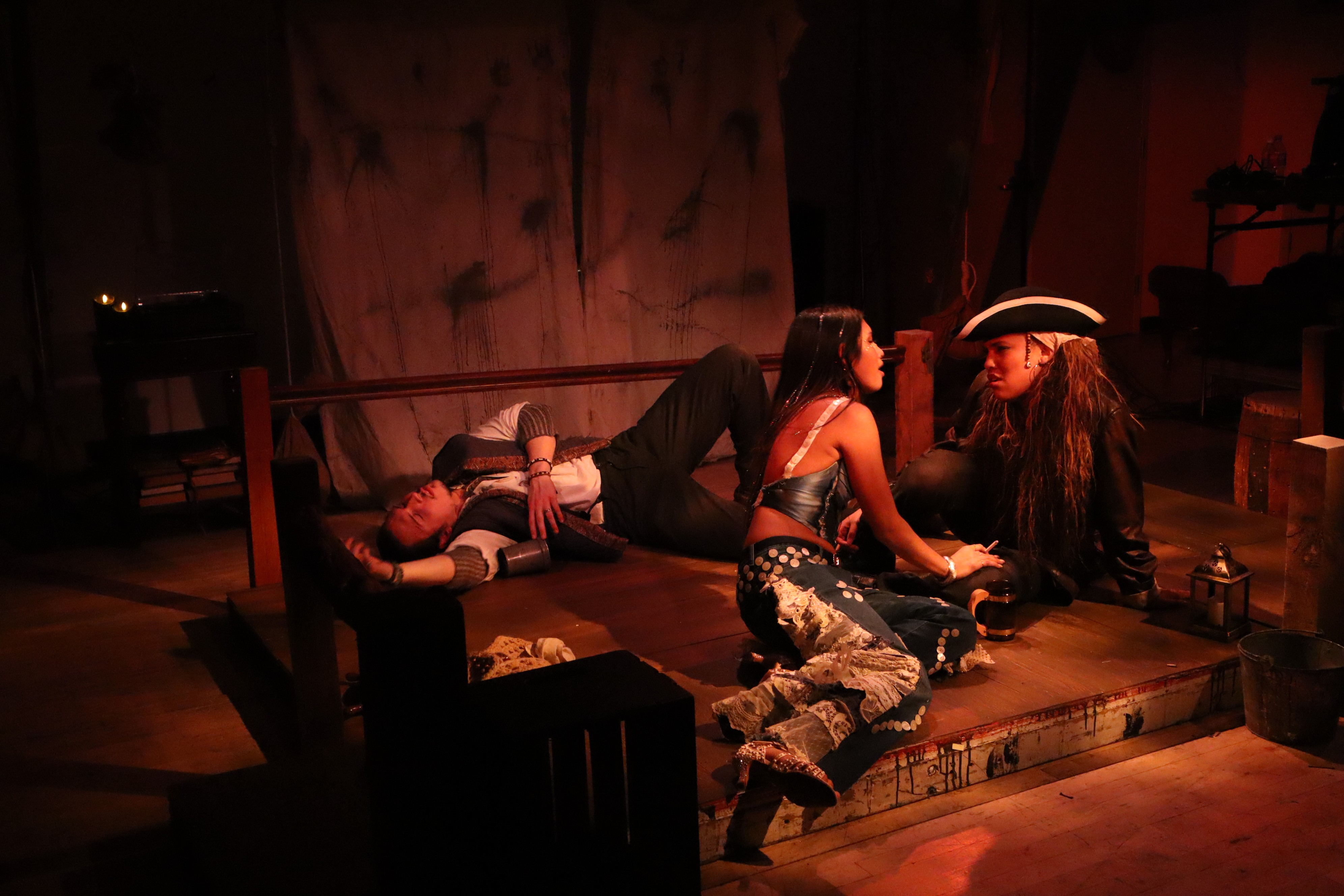
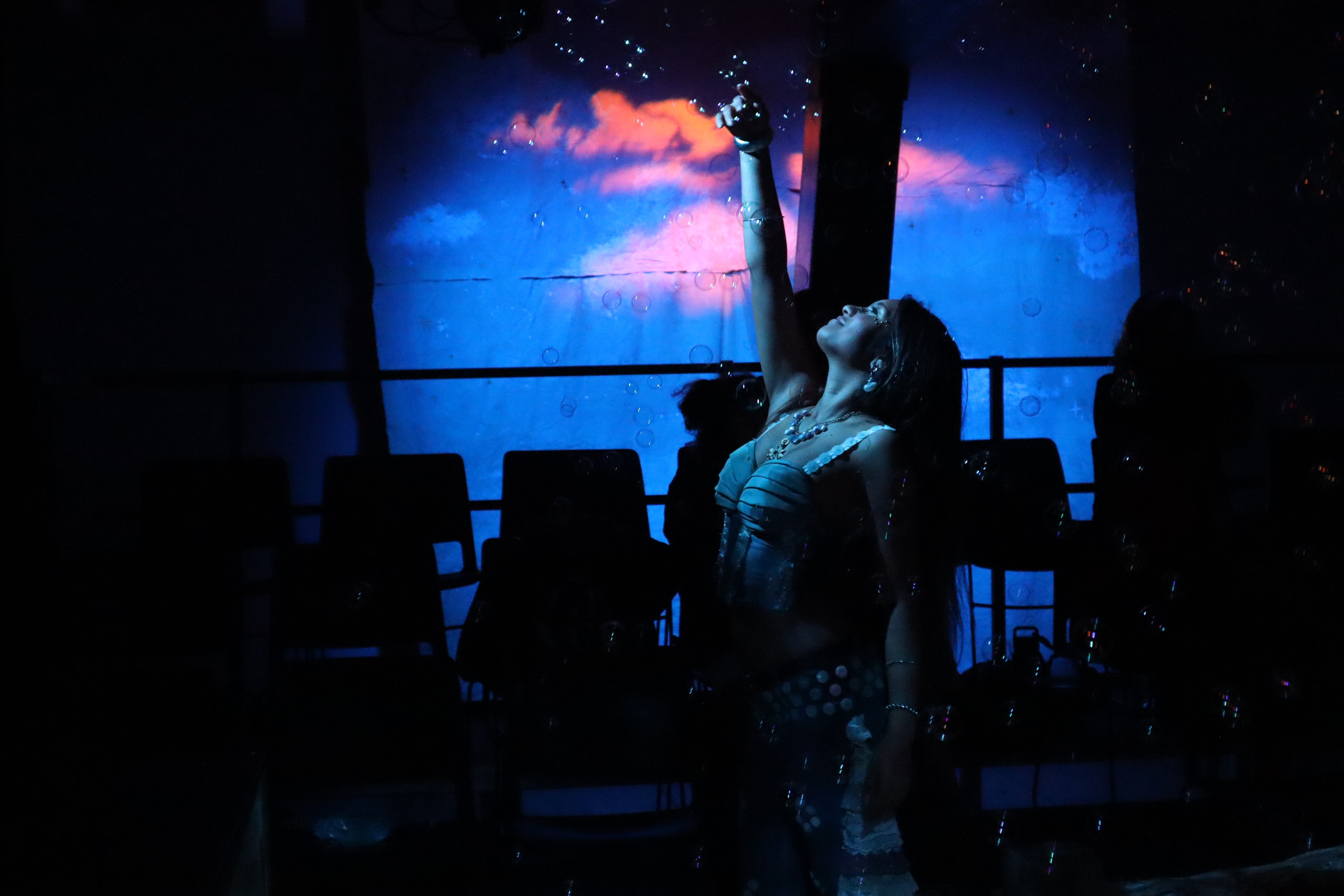
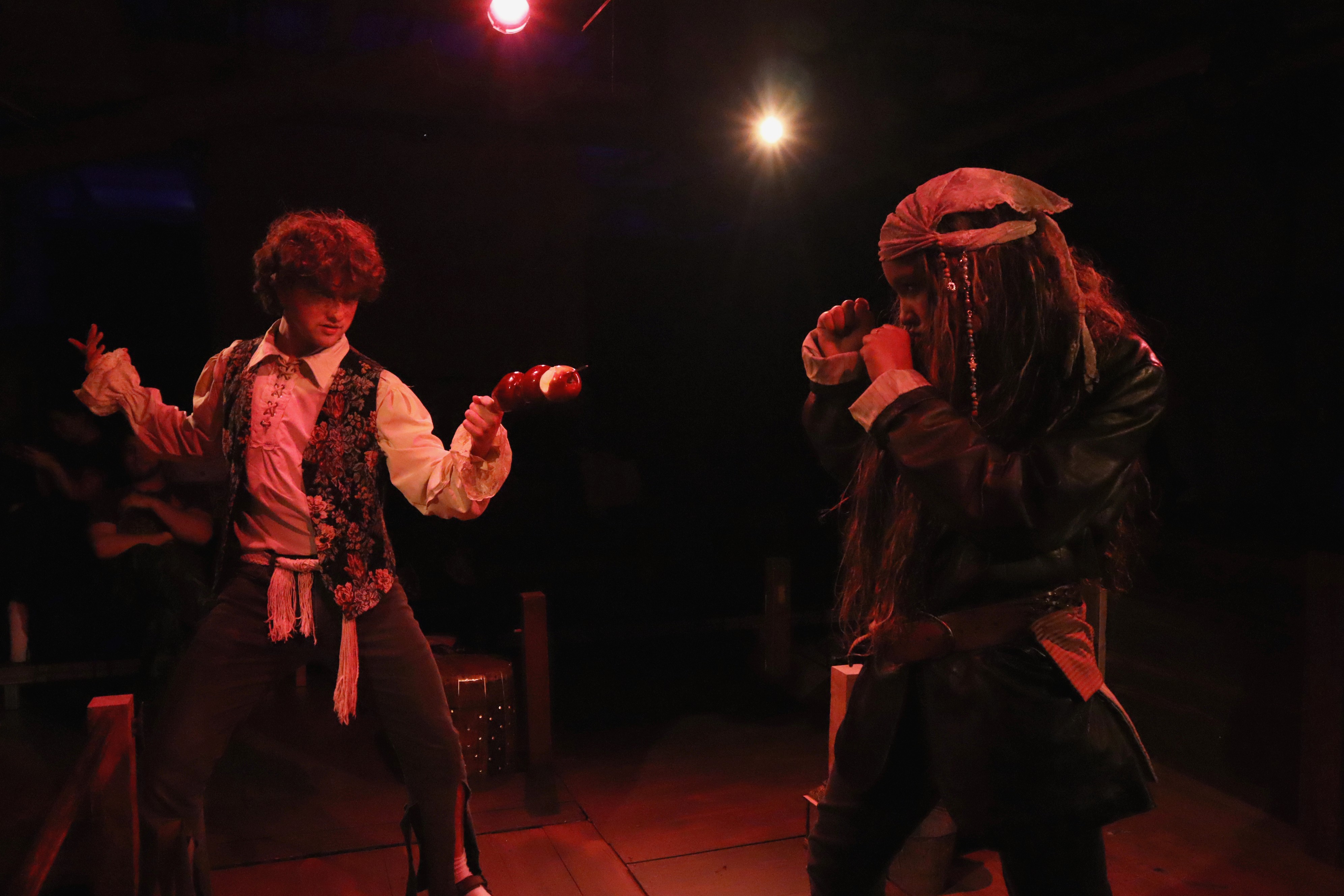
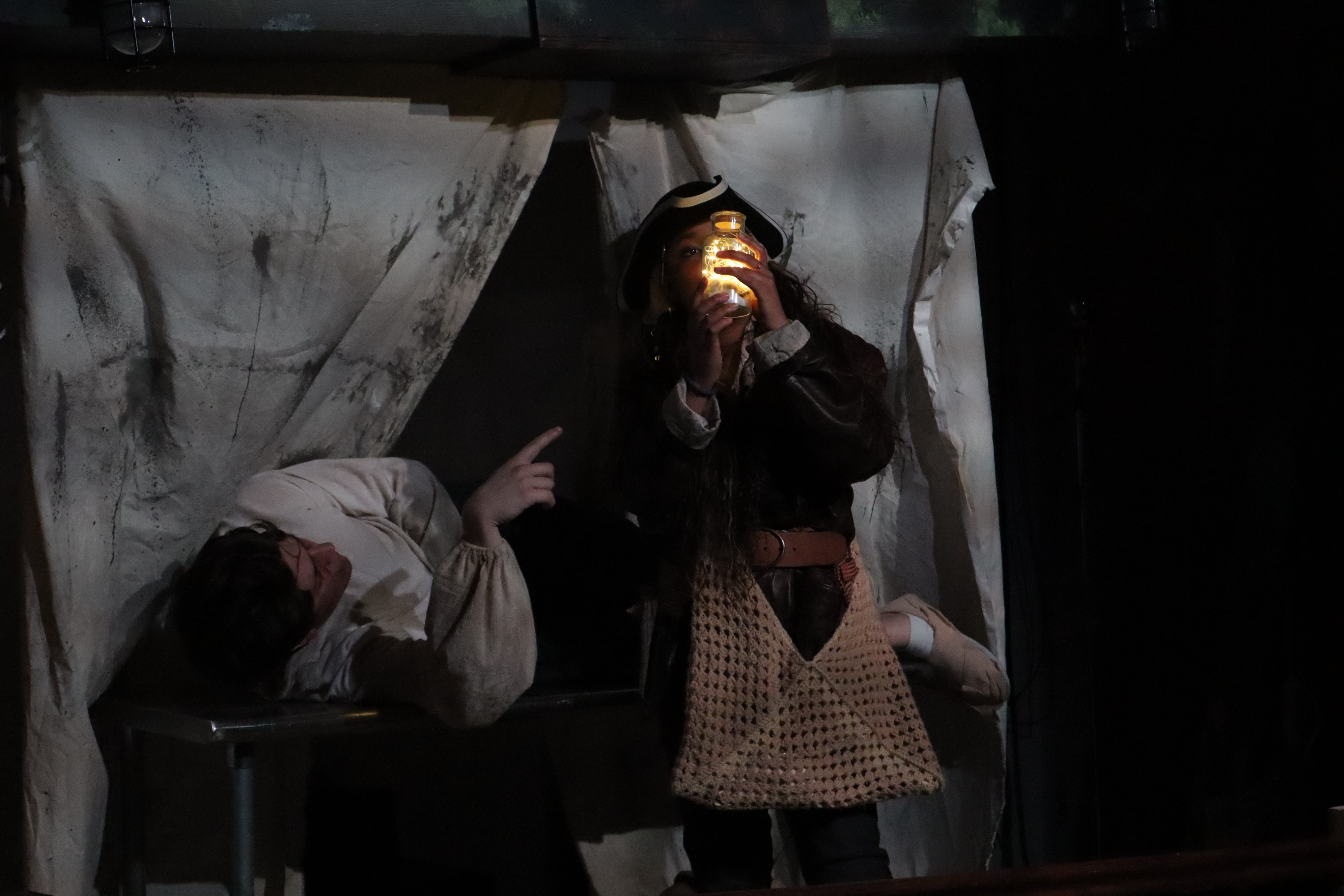
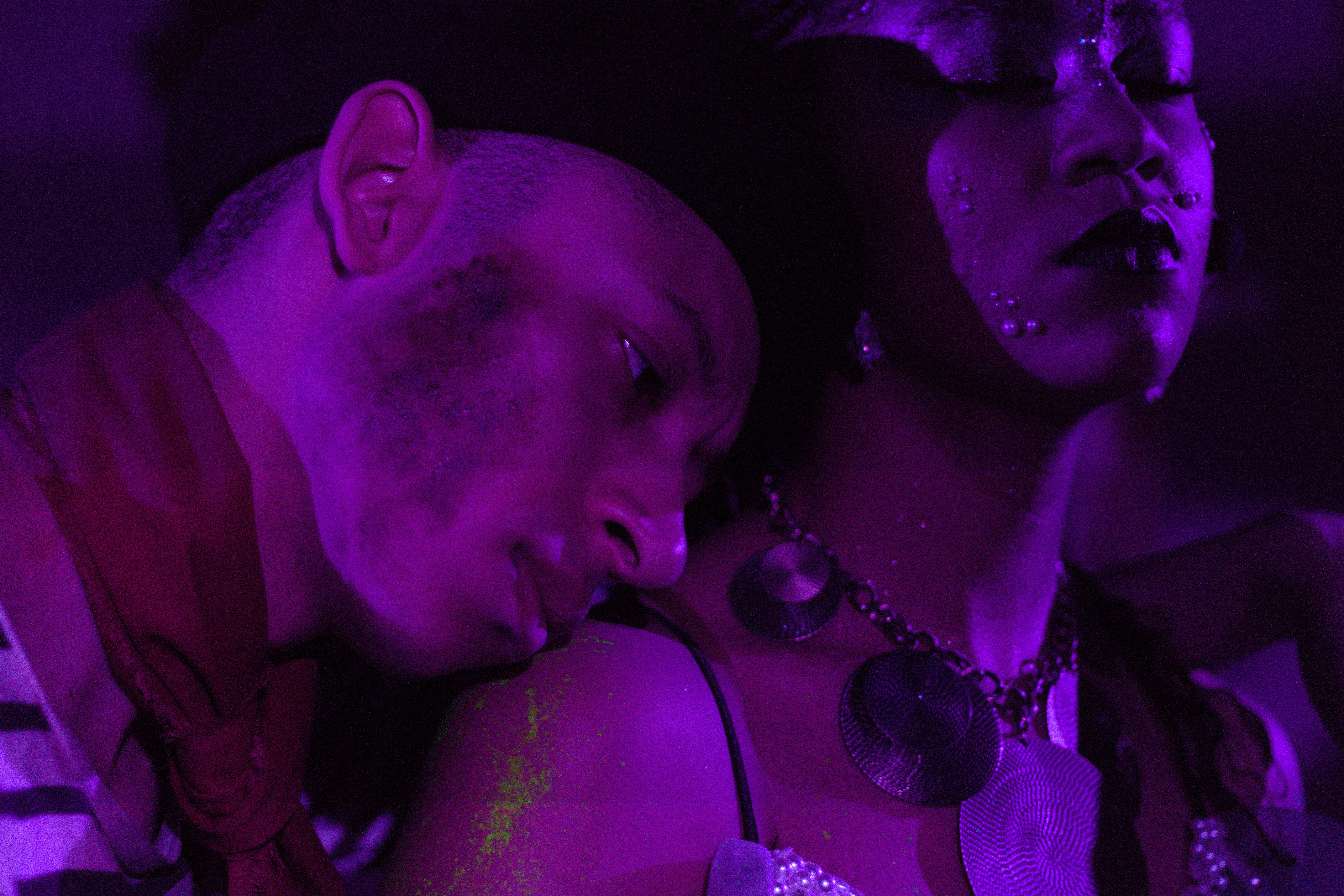
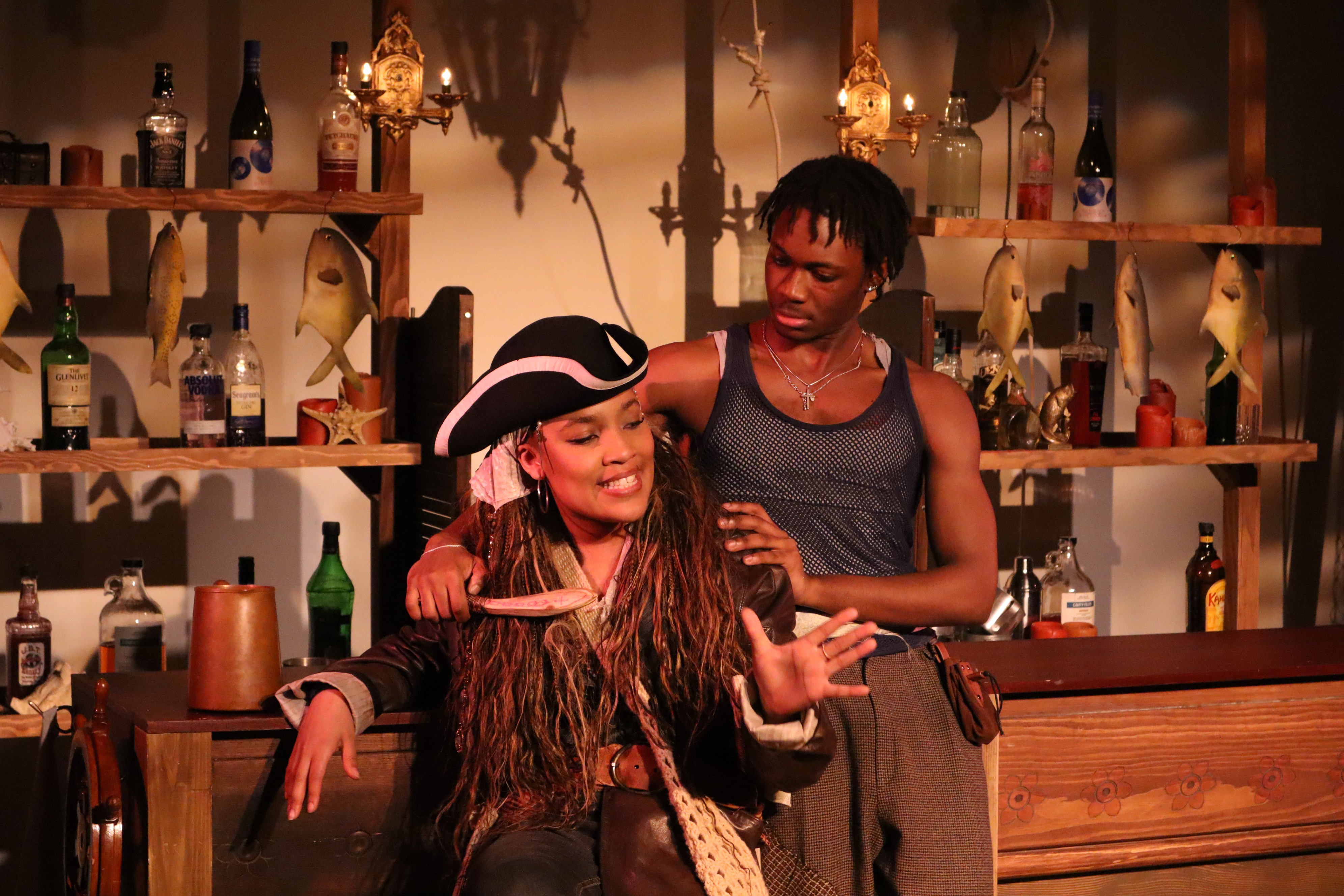
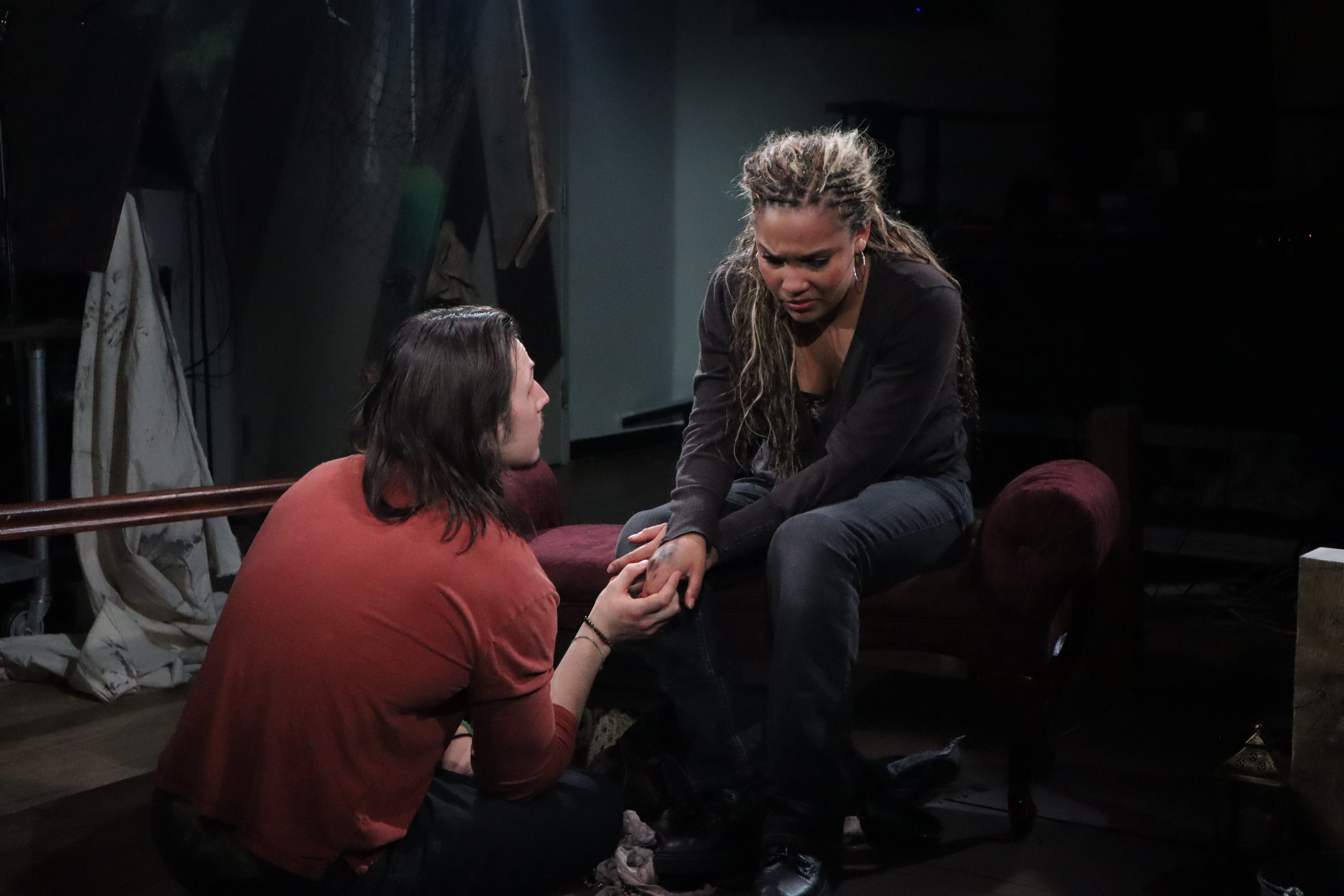
Orange Sky at Night, Sailor’s Delight is a story about Darcy, a writer, who creates a vibrant, whimsical, and fantastical Pirate World as an escapism tactic. The Siren informs the audience that an orange sky in the morning indicates a brewing storm, dangerous to sailors. Driven by grief after losing her friend Wesley, Darcy Dukes, the pirate, functions as both storm and sailor. As the storm in this metaphor, Darcy Dukes engages with a wide array of zany characters, all of which she treats as mere means to the end of reviving Wesley. Darcy Dukes cheats and steals, unrepentant in her actions. With Darcy as the sailor, her grief functions as the hungry storm, it makes her self-destructive and avoidant. Akin to how Frankenstein is created as a vessel for Darcy Dukes to house Wesley’s soul, this play is a vessel for Darcy to house her grief. So long as Darcy retains the pain of her grief, she will retain her memory of Wesley. It is just as much an act of self-flagellation as it is an act of remembrance. However, just as Darcy Dukes’ efforts to revive Wesley fail, Darcy’s efforts to encapsulate her pain also fail. Both reveal themselves to be maladaptive coping mechanisms—they help in the short term, but fail to address the root of the problem. This results in hints of reality steadily seeping into the Pirate World, as though the structural integrity of Darcy’s escapist fantasy is crumbling. This crumbling should feel unnerving. Something is wrong but Darcy Dukes cannot tell what it is, nor can the audience. Therefore, when the fantasy breaks and the sharp edges of reality crash down, it is painfully cathartic—something had to give, and finally, it does. Darcy has no other choice but to address her pain head on and allow herself vulnerability—she feeds the storm. It is only then that Darcy is able to loosen her hold on her grief, if only for a moment. The Siren informs us that there is an orange sky this night. The storm has receded, we may delight.
Orange Sky at Night, Sailor’s Delight is a story about Darcy, a writer, who creates a vibrant, whimsical, and fantastical Pirate World as an escapism tactic. The Siren informs the audience that an orange sky in the morning indicates a brewing storm, dangerous to sailors. Driven by grief after losing her friend Wesley, Darcy Dukes, the pirate, functions as both storm and sailor. As the storm in this metaphor, Darcy Dukes engages with a wide array of zany characters, all of which she treats as mere means to the end of reviving Wesley. Darcy Dukes cheats and steals, unrepentant in her actions. With Darcy as the sailor, her grief functions as the hungry storm, it makes her self-destructive and avoidant. Akin to how Frankenstein is created as a vessel for Darcy Dukes to house Wesley’s soul, this play is a vessel for Darcy to house her grief. So long as Darcy retains the pain of her grief, she will retain her memory of Wesley. It is just as much an act of self-flagellation as it is an act of remembrance. However, just as Darcy Dukes’ efforts to revive Wesley fail, Darcy’s efforts to encapsulate her pain also fail. Both reveal themselves to be maladaptive coping mechanisms—they help in the short term, but fail to address the root of the problem. This results in hints of reality steadily seeping into the Pirate World, as though the structural integrity of Darcy’s escapist fantasy is crumbling. This crumbling should feel unnerving. Something is wrong but Darcy Dukes cannot tell what it is, nor can the audience. Therefore, when the fantasy breaks and the sharp edges of reality crash down, it is painfully cathartic—something had to give, and finally, it does. Darcy has no other choice but to address her pain head on and allow herself vulnerability—she feeds the storm. It is only then that Darcy is able to loosen her hold on her grief, if only for a moment. The Siren informs us that there is an orange sky this night. The storm has receded, we may delight.
Orange Sky at Night, Sailor’s Delight is a story about Darcy, a writer, who creates a vibrant, whimsical, and fantastical Pirate World as an escapism tactic. The Siren informs the audience that an orange sky in the morning indicates a brewing storm, dangerous to sailors. Driven by grief after losing her friend Wesley, Darcy Dukes, the pirate, functions as both storm and sailor. As the storm in this metaphor, Darcy Dukes engages with a wide array of zany characters, all of which she treats as mere means to the end of reviving Wesley. Darcy Dukes cheats and steals, unrepentant in her actions. With Darcy as the sailor, her grief functions as the hungry storm, it makes her self-destructive and avoidant. Akin to how Frankenstein is created as a vessel for Darcy Dukes to house Wesley’s soul, this play is a vessel for Darcy to house her grief. So long as Darcy retains the pain of her grief, she will retain her memory of Wesley. It is just as much an act of self-flagellation as it is an act of remembrance. However, just as Darcy Dukes’ efforts to revive Wesley fail, Darcy’s efforts to encapsulate her pain also fail. Both reveal themselves to be maladaptive coping mechanisms—they help in the short term, but fail to address the root of the problem. This results in hints of reality steadily seeping into the Pirate World, as though the structural integrity of Darcy’s escapist fantasy is crumbling. This crumbling should feel unnerving. Something is wrong but Darcy Dukes cannot tell what it is, nor can the audience. Therefore, when the fantasy breaks and the sharp edges of reality crash down, it is painfully cathartic—something had to give, and finally, it does. Darcy has no other choice but to address her pain head on and allow herself vulnerability—she feeds the storm. It is only then that Darcy is able to loosen her hold on her grief, if only for a moment. The Siren informs us that there is an orange sky this night. The storm has receded, we may delight.
FEATURING
Carrie Johnson as Darcy Dukes
Cristian Medeiros as Billy Bullets
Alexander Shayeb as Frankenstein Sinatra
Sheba Jade as The Siren
Tobias Foreman as Flip
Ben Miller as Johnny Appleseed
Rylan Carroll as The French Person
Jill Acosta as Marcy Mermaid
Playwright: Maggie Needham
Director: Lisa Virginia
Asst. Director: Elias Bernstein
Production Stage Manager: Jessica Stekloff
Stage Manager: Sara Hecht
Scenic Design: Sam Deetjen
Assoc. Scenic Design: Ian Rios
Asst. Scenic Design: Brian Muñoz Reyes
Lighting Design: Kal Larsen
Asst. Lighting Design:
Sound Design: Elijah Warrington
Assoc. Sound Design: Kei Sugae
Costume Design: Amy Orner
Asst. Costume Design: Isabelle Diaz
Hair/Makeup Design: Chandler Wheeler
Asst. Hair/Makeup Design:
Props Design: Amanda Burch
Intimacy Coordinator: Pradanya Subramanyan
Fight Choreographer: Alexander Shayeb
Production Manager: Ian Rios
Social Media Manager: Jyonnah Ware
Production Photography: Lisa Virginia & Kei Sugae
Graphic Design: Elias Bernstein & Camryn Corron
“The Misgivings”:
Violins: Valeria Fernández, Sam Guzman-Almonte, and Kendall Mulligan
Viola: Leeya Azemoun
Cello: Pavel Vasilyev
Double Bass: Peter Wiseman
French Horn: Puck Carrasquillo
Flute: Andrew Shapiro
FEATURING
Carrie Johnson as Darcy Dukes
Cristian Medeiros as Billy Bullets
Alexander Shayeb as Frankenstein Sinatra
Sheba Jade as The Siren
Tobias Foreman as Flip
Ben Miller as Johnny Appleseed
Rylan Carroll as The French Person
Jill Acosta as Marcy Mermaid
Playwright: Maggie Needham
Director: Lisa Virginia
Asst. Director: Elias Bernstein
Production Stage Manager: Jessica Stekloff
Stage Manager: Sara Hecht
Scenic Design: Sam Deetjen
Assoc. Scenic Design: Ian Rios
Asst. Scenic Design: Brian Muñoz Reyes
Lighting Design: Kal Larsen
Asst. Lighting Design:
Sound Design: Elijah Warrington
Assoc. Sound Design: Kei Sugae
Costume Design: Amy Orner
Asst. Costume Design: Isabelle Diaz
Hair/Makeup Design: Chandler Wheeler
Asst. Hair/Makeup Design:
Props Design: Amanda Burch
Intimacy Coordinator: Pradanya Subramanyan
Fight Choreographer: Alexander Shayeb
Production Manager: Ian Rios
Social Media Manager: Jyonnah Ware
Production Photography: Lisa Virginia & Kei Sugae
Graphic Design: Elias Bernstein & Camryn Corron
“The Misgivings”:
Violins: Valeria Fernández, Sam Guzman-Almonte, and Kendall Mulligan
Viola: Leeya Azemoun
Cello: Pavel Vasilyev
Double Bass: Peter Wiseman
French Horn: Puck Carrasquillo
Flute: Andrew Shapiro
Production Photography: Lisa Virginia & Kei Sugae
Graphic Design: Elias Bernstein & Camryn Corron
“The Misgivings”:
Violins: Valeria Fernández, Sam Guzman-Almonte, and Kendall Mulligan
Viola: Leeya Azemoun
Cello: Pavel Vasilyev
Double Bass: Peter Wiseman
French Horn: Puck Carrasquillo
Flute: Andrew Shapiro
Orange Sky at Night, Sailor’s Delight is a story about Darcy, a writer, who creates a vibrant, whimsical, and fantastical Pirate World as an escapism tactic. The Siren informs the audience that an orange sky in the morning indicates a brewing storm, dangerous to sailors. Driven by grief after losing her friend Wesley, Darcy Dukes, the pirate, functions as both storm and sailor. As the storm in this metaphor, Darcy Dukes engages with a wide array of zany characters, all of which she treats as mere means to the end of reviving Wesley. Darcy Dukes cheats and steals, unrepentant in her actions. With Darcy as the sailor, her grief functions as the hungry storm, it makes her self-destructive and avoidant. Akin to how Frankenstein is created as a vessel for Darcy Dukes to house Wesley’s soul, this play is a vessel for Darcy to house her grief. So long as Darcy retains the pain of her grief, she will retain her memory of Wesley. It is just as much an act of self-flagellation as it is an act of remembrance. However, just as Darcy Dukes’ efforts to revive Wesley fail, Darcy’s efforts to encapsulate her pain also fail. Both reveal themselves to be maladaptive coping mechanisms—they help in the short term, but fail to address the root of the problem. This results in hints of reality steadily seeping into the Pirate World, as though the structural integrity of Darcy’s escapist fantasy is crumbling. This crumbling should feel unnerving. Something is wrong but Darcy Dukes cannot tell what it is, nor can the audience. Therefore, when the fantasy breaks and the sharp edges of reality crash down, it is painfully cathartic—something had to give, and finally, it does. Darcy has no other choice but to address her pain head on and allow herself vulnerability—she feeds the storm. It is only then that Darcy is able to loosen her hold on her grief, if only for a moment. The Siren informs us that there is an orange sky this night. The storm has receded, we may delight.
Orange Sky at Night, Sailor’s Delight is a story about Darcy, a writer, who creates a vibrant, whimsical, and fantastical Pirate World as an escapism tactic. The Siren informs the audience that an orange sky in the morning indicates a brewing storm, dangerous to sailors. Driven by grief after losing her friend Wesley, Darcy Dukes, the pirate, functions as both storm and sailor. As the storm in this metaphor, Darcy Dukes engages with a wide array of zany characters, all of which she treats as mere means to the end of reviving Wesley. Darcy Dukes cheats and steals, unrepentant in her actions. With Darcy as the sailor, her grief functions as the hungry storm, it makes her self-destructive and avoidant. Akin to how Frankenstein is created as a vessel for Darcy Dukes to house Wesley’s soul, this play is a vessel for Darcy to house her grief. So long as Darcy retains the pain of her grief, she will retain her memory of Wesley. It is just as much an act of self-flagellation as it is an act of remembrance. However, just as Darcy Dukes’ efforts to revive Wesley fail, Darcy’s efforts to encapsulate her pain also fail. Both reveal themselves to be maladaptive coping mechanisms—they help in the short term, but fail to address the root of the problem. This results in hints of reality steadily seeping into the Pirate World, as though the structural integrity of Darcy’s escapist fantasy is crumbling. This crumbling should feel unnerving. Something is wrong but Darcy Dukes cannot tell what it is, nor can the audience. Therefore, when the fantasy breaks and the sharp edges of reality crash down, it is painfully cathartic—something had to give, and finally, it does. Darcy has no other choice but to address her pain head on and allow herself vulnerability—she feeds the storm. It is only then that Darcy is able to loosen her hold on her grief, if only for a moment. The Siren informs us that there is an orange sky this night. The storm has receded, we may delight.